
Treatment guide · Recovery & flying home
Breast augmentation in Seoul: your recovery, week by week, and when to fly home
Breast augmentation is one of the best-planned operations a traveller can have: the steps are predictable, most people go home the same day or after one night, and the first weeks follow a known pattern. The one thing to plan carefully is the gap between surgery and the flight to Indonesia. This guide is about implant augmentation; a lift or reduction takes longer, as explained below.
Facts checked:
Recovery at a glance
Plan on 7–14 days in Seoul after implant surgery. The NHS and the UK plastic surgeons' association (BAPRAS) say not to fly for at least 5–7 days after breast surgery, and the British Association of Aesthetic Plastic Surgeons (BAAPS) advises patients travelling four hours or more to stay 1–2 weeks after this kind of operation. Seoul to Jakarta is about seven hours, so the upper end is the comfortable plan.
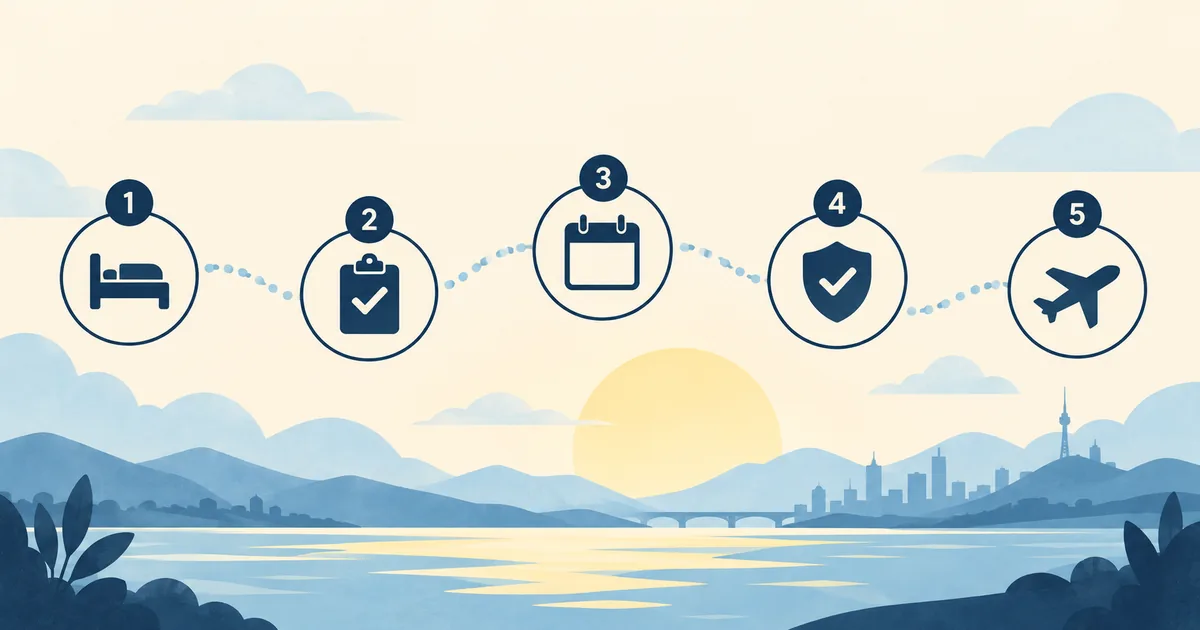
- Surgery day. Usually home to your hotel the same day or after one night.
- First check. Booked before you leave the clinic; your surgeon checks the wound and any drain.
- Weeks 1–2. Stitches out (unless dissolvable) and any drain removed; you are up and walking.
- Fit-to-fly review. The surgeon who operated sees you again before you travel.
- Flight home. Generally no sooner than 5–7 days; for a flight of 4 hours or more, UK surgeons advise staying 1–2 weeks.
Day by day, week by week
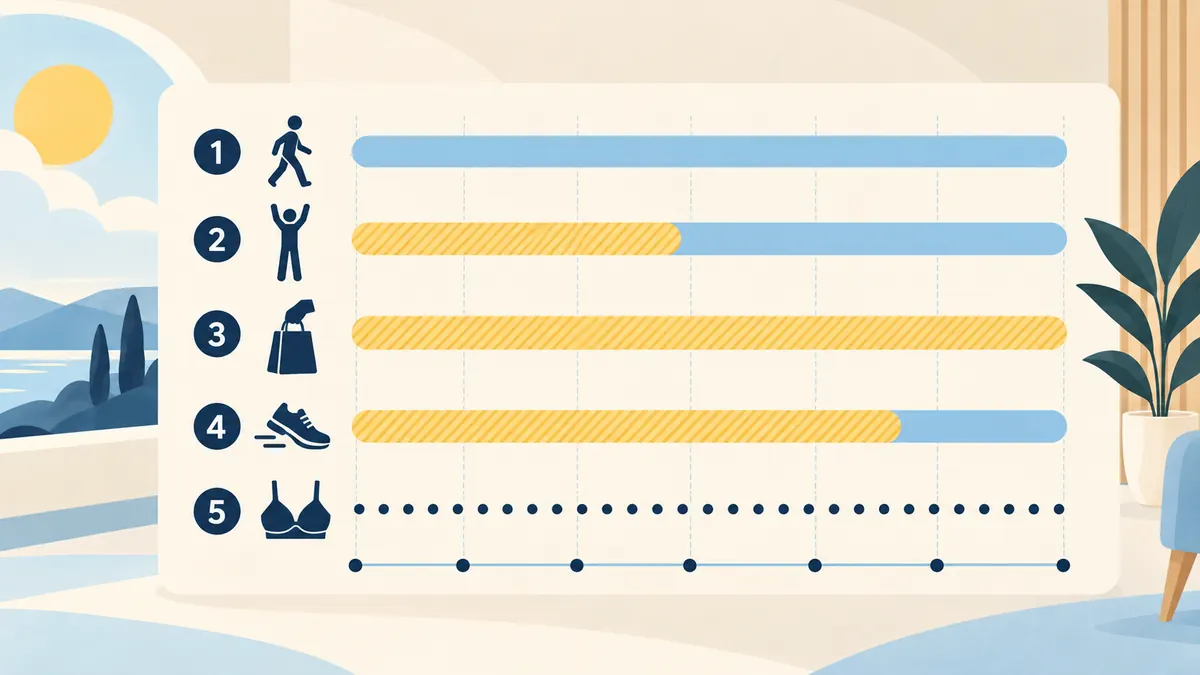
- Walking. Up and walking from the first days. Short, gentle walks help circulation.
- Arms overhead. Do not lift anything over your head for the first 2–3 weeks; avoid overstretching your arms for 3–6 weeks.
- Lifting. Nothing heavier than about 2 kg (5 lb) for around six weeks. A packed cabin bag is far over that.
- Strenuous exercise. None for 4–6 weeks, then build up as your surgeon advises.
- Support bra. Worn around the clock, as instructed.
Hatched bars mean wait. Your surgeon may relax or extend any of these.
- Surgery day. Many patients go home after an hour or so once stable; others stay one night. Rest, with someone to help you for the first day.
- Days 1–5. The sharpest discomfort usually eases within one to five days. Bleeding into the implant pocket is a risk for the first several days, so rest and avoid lifting. Move your arms carefully and do not lift anything over your head for the first 2–3 weeks. Wear the support bra or band around the clock, as instructed.
- First check. Your clinic books it before you leave. Drains are not routine in augmentation and many surgeons do not use them; if one is placed, it usually comes out after about two to a few days.
- Days 7–14. External stitches come out at about one to two weeks unless they are dissolvable. Swelling and bruising settle over one to two weeks. Many people are back at a desk job in one to two weeks.
- Weeks 2–6. Lift nothing heavier than about 2 kg (5 lb) for around six weeks, a limit university hospital instructions give; no strenuous exercise for 4–6 weeks and no overstretching your arms for 3–6 weeks. Your surgeon may relax this sooner. Keep everyday items within easy reach rather than reaching up.
- Months 3–6. The implants drop and soften into their final position ("drop and fluff"): about 3–4 months per UK surgeons' guidance, up to six for some. Scars are red for around six weeks, then fade over months.
Why you stay in Seoul
- Review by your own surgeon before you travel. BAAPS guidance is explicit that the surgeon who operated should see you at least once before you go home.
- Stitches and drains. Removal at about one to two weeks (drains sooner) is simplest at the clinic that placed them.
- Early problems show early. Bleeding (haematoma) usually happens soon after surgery, occasionally up to two weeks later, and is treated by the surgeon in theatre. Infection, if it happens, usually shows in the first two to three weeks.
- Clot risk. Surgery and long flights each raise the risk of a blood clot; the two together are the reason flights are timed in days, not hours.
If your stay will be longer than a short visit, or a family member is coming to care for you, check which visa fits: see Entry rules and visas for Indonesian travellers. Kordy can help arrange the hospital documents for a medical visa.
On the flight home
- Book an aisle seat, walk the cabin regularly and do ankle and calf exercises in your seat.
- Drink water, skip alcohol and go easy on coffee.
- Wear compression stockings if your surgeon advises them; BAAPS recommends them for two weeks after this kind of surgery for travellers.
- Wear your support bra and loose clothing.
- Do not lift a bag into the overhead locker. Carry only a small bag that fits under the seat, check in everything else, and ask a companion for help. A packed cabin bag is far over a 2 kg limit.
- Do not take aspirin or blood thinners for the flight unless your doctor prescribed them.
Flying with breast implants is safe; cabin pressure does not damage them. The precautions are about the recent operation, not the implants.
Lift or reduction: allow longer
A breast lift often involves stitches removed in stages over about three weeks, and no lifting for the first two weeks. A breast reduction usually means one or two nights in hospital, drains for a day or two, two to three weeks off work and two to six weeks to recover. Longer operations, or several areas at once, move into BAAPS's higher group, where the advice is to stay 2–4 weeks before a long journey.
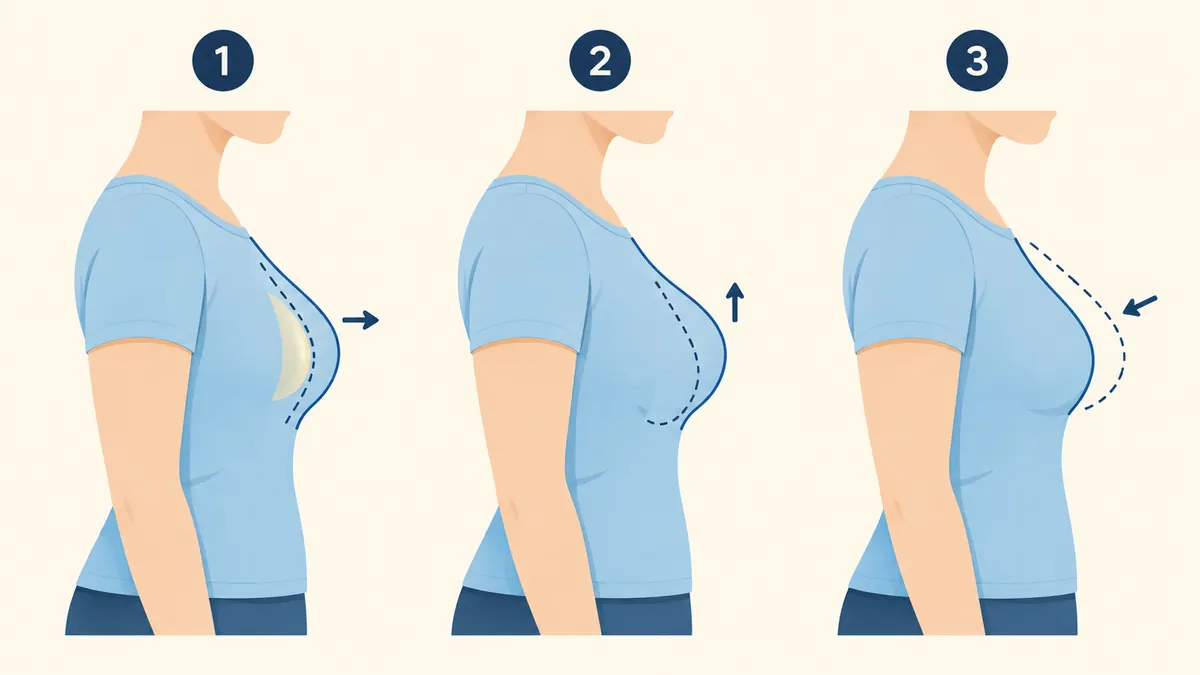
- Augmentation. An implant placed behind the breast tissue or the chest muscle adds volume. The breast's position stays about the same.
- Lift. Excess skin is removed and the breast is reshaped so it sits higher and firmer. Volume stays about the same.
- Reduction. Breast tissue and skin are removed, so the breast is smaller and usually sits a little higher.
Dashed line: before. Schematic outlines showing a typical, modest change; your surgeon plans the actual one.
Warning signs
Before you leave and back home
- Get an English summary of the operation, your medication list, and the implant device card (maker, model, size and serial number). Photograph them.
- Agree how to reach the clinic after you fly, and plan a phone or video follow-up. BAAPS also recommends knowing how to reach emergency care at home.
- Arrange a local doctor in Indonesia who can see you if needed, and keep the clinic's paperwork with you.
- For silicone implants, the U.S. FDA advises a first ultrasound or MRI at 5–6 years and then every 2–3 years, even without symptoms.
- Breast implants are not lifetime devices. See a doctor for any new swelling, lump or pain near an implant, even years later.
Considering one of these? Tell us your dates and we will plan the clinic visits around them.
Sources
- Breast augmentation recovery
- Breast enlargement (implants)
- Your guide to breast augmentation (2021)
- Breast augmentation aftercare and recovery
- What does 'drop and fluff' mean after breast augmentation?
- Cosmetic Tourism Guidelines (September 2023)
- Cosmetic surgery abroad
- Cosmetic surgery abroad
- Deep vein thrombosis
- Blood clots and travel
- Breast augmentation recovery: what to expect
- Cosmetic breast surgery: discharge
- Drains in breast augmentation (2023)
- Breast augmentation FAQ: how long do I have to wait to exercise, drive and lift things?
- Breast augmentation (patient handout)
- Breast enlargement surgery: what to expect at home
- Breast augmentation
- Breast lift aftercare and recovery
- Breast reduction (female)
- Breast Implants: Certain Labeling Recommendations to Improve Patient Communication
- Questions and answers about BIA-ALCL
This guide summarises published guidance so you can plan and ask better questions. It is not medical advice. Your doctor assesses you in person and makes every treatment decision, including when you are fit to fly.
All treatment guides