
Thread lift
Lift the cheeks and jawline without surgery
Dissolvable threads made of PDO, PCL or PLLA, with small barbs or cogs, are placed under the skin through tiny entry points under local anaesthetic to lift the cheeks and jawline. Swelling, tightness, small dimples or bruising usually settle within a week, though tightness when opening the mouth wide can last 1–2 weeks. Plan at least 3 days in Seoul so the clinic can check you before you fly.
- Downtime
- 3–7 days
- Minimum stay
- 3 days
- Sessions
- 1
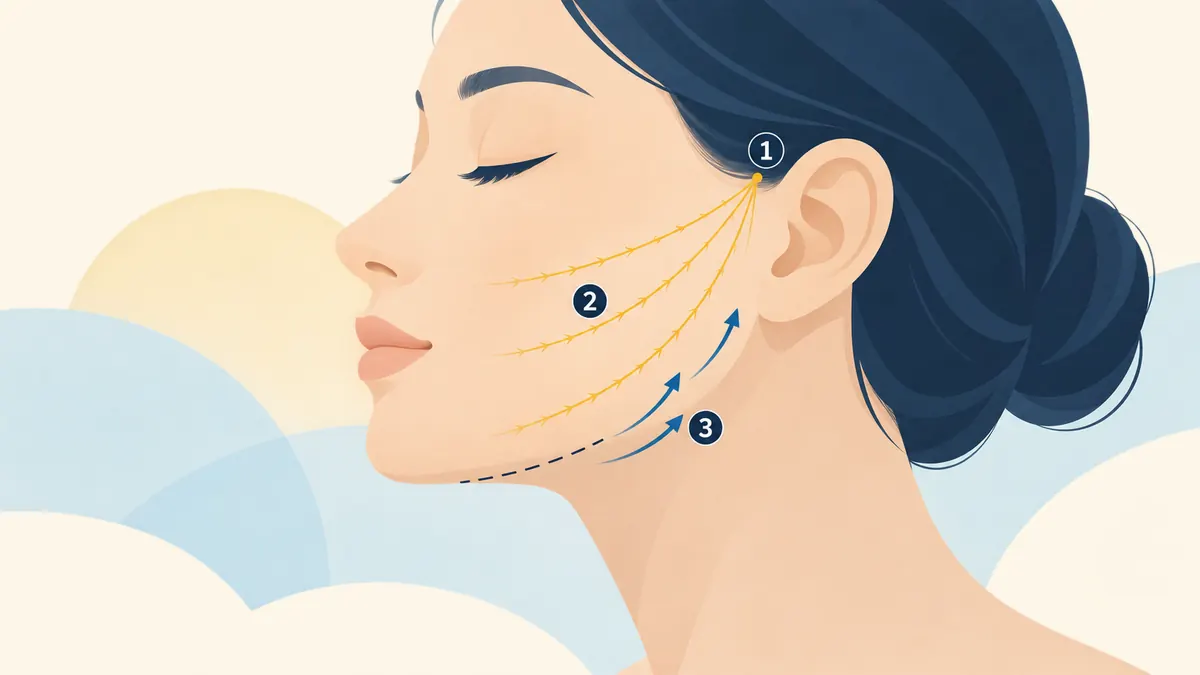
- Entry point. A tiny opening near the hairline, under local anaesthetic. No incision to stitch.
- Barbed threads. Dissolvable threads with small barbs sit under the skin and hold the tissue.
- The lift. Cheeks and jawline are drawn up and back. The threads dissolve over months while collagen forms around them.
Schematic. The change shown is modest, as it is in practice.
Estimated price range
KRW 500,000 – 2,000,000 · per face
≈ USD 372 – 1,486
Varies by clinic and your condition. The final price is confirmed after consultation.
Converted at a fixed rate as of 2026-09-11
Good to know
- Avoid wide yawning, facial massage and dental work for about 2–4 weeks while the threads settle.
- Sleep on your back and avoid saunas and strenuous exercise for the first week.
- A thread lift does not replace a facelift for heavy sagging; your doctor advises at consultation which suits you.
- Tell your doctor about blood thinners, recent filler or any skin infection in the area.
Questions
How long does the lift last?
Months, often around a year, depending on the thread type and your skin. PCL and PLLA threads tend to last longer than PDO.
Thread lift or facelift?
Threads suit mild to moderate sagging with a short recovery. Heavier sagging usually needs a surgical facelift, and your doctor will tell you honestly which fits.
Will people be able to tell?
Small dimples or puckering can be visible for the first days and usually settle within a week. Book with some buffer before photos or events.
Does it hurt?
Local anaesthetic is used, so most people feel pressure and tugging rather than pain. Some tenderness for a few days afterwards is common.