
SMILE LASIK
Glasses-free in a 3-day trip
Small-incision lenticule extraction reshapes the cornea through a 2–4 mm opening, without creating a flap. A typical schedule is examination on day 1, surgery on day 2, and a check-up on day 3 before you fly home. Vision usually clears within a day or two.
- Downtime
- 1–2 days
- Minimum stay
- 3 days
- Sessions
- 1
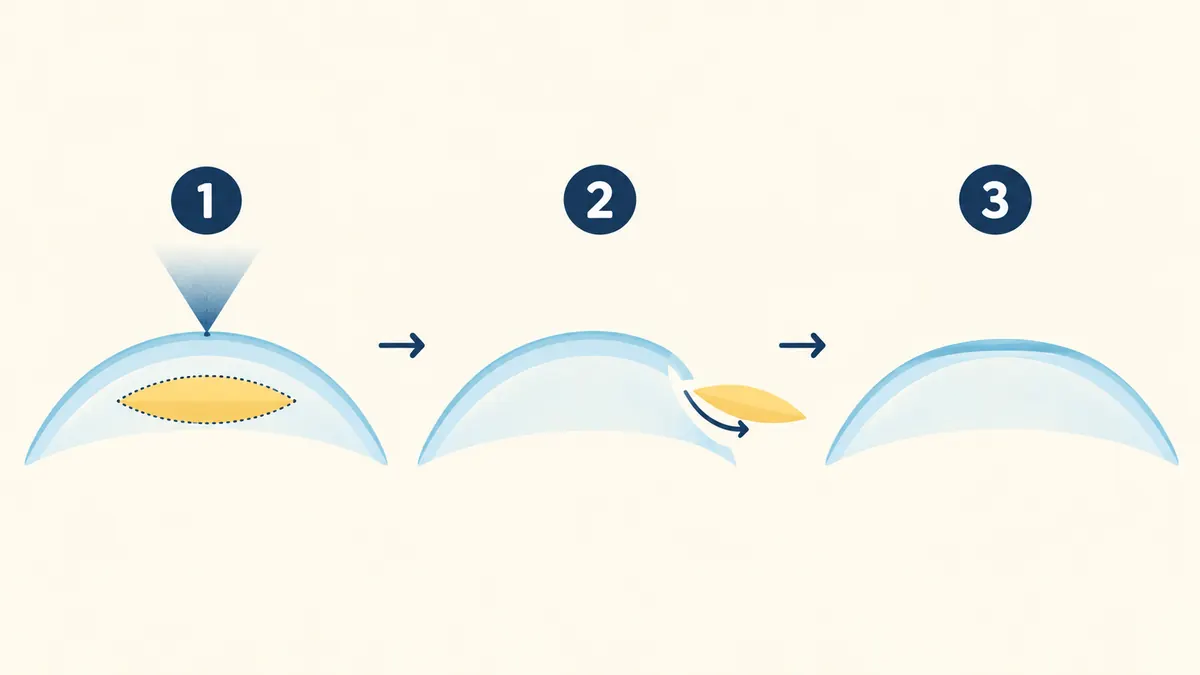
- Inside the cornea. The femtosecond laser shapes a thin lens-shaped disc of tissue (the lenticule) within the cornea.
- A small incision. The surgeon removes the lenticule through a small opening. No flap is cut.
- Reshaped. With that tissue gone the cornea's curve changes slightly, which corrects the focus.
Schematic, not to scale.
Estimated price range
KRW 2,500,000 – 4,500,000 · both eyes
≈ USD 1,857 – 3,344
Varies by clinic and your condition. The final price is confirmed after consultation.
Converted at a fixed rate as of 2026-09-11
Good to know
- Stop soft contact lenses 1–2 weeks before the examination and hard lenses 2–3 weeks before, or the corneal measurements will be inaccurate.
- Expect dry eyes for about a month; use the prescribed drops and carry them on the plane.
- Do not rub your eyes, and wear the protective shield while sleeping for the first few nights.
- No swimming, sauna or eye makeup for 2 weeks.
Questions
SMILE, LASIK or LASEK?
SMILE uses the smallest opening and no flap, but suitability depends on your corneal thickness and prescription. The eye doctor decides after the examination.
Can I fly the day after surgery?
Most clinics clear patients after the day-1 post-op check, which makes a 3-day trip realistic.
What if I am not a candidate?
The pre-op examination may point to LASEK or a lens implant instead, and you will know before any surgery is booked.
Will I need glasses again later?
Reading glasses are still likely with age, and long-term results vary between individuals.